PS-edu · Section catalog

Sections, in this design system’s voice.

Every canonical section pattern from SECTION-PATTERNS.md, plus the three signature patterns unique to PS-edu, rendered in the editorial-scholarly visual language: Fraunces display headings, EB Garamond body, Inter UI, and the orange-and-tan accent system over warm putty grounds.

Demo content is set in the voice of Trinity Reformed Church, our recurring fictional Reformed-confessional tenant. Each card shows the pattern’s code-handle, its purpose in one line, and a live, polished render of the section as it would ship.

19 patterns 3 signature Editorial direction

Hero patterns

Top-of-page openers. Photo-led for institutional homepages, type-only for landings and statements.

hero-photo-led

Top-of-homepage. Establishes mood with a real photo and a short editorial headline.

Hero

A confessional Reformed church · Founded 1991

Word and table, week by week.

Trinity Reformed is a congregation of pastors and lay families in north Phoenix shaped by the historic faith — gathered each Lord’s day around the preached Word, the Lord’s Table, and one another.

Sundays · 9:30 AM & 11:00 AM 4220 N 16th Street · Phoenix, AZ
hero-centered

Typography-only hero. No photo. For internal landings or high-statement homepages.

Hero

For visitors

If you’ve never been to a Reformed service, start here.

A short note from our pastors on what to expect on your first Sunday at Trinity, what we believe Word and Table are doing in the room, and why we keep doing it the way we do, week after week.

Read the visitor’s note

Header & chrome

Site-wide elements that bracket the page: announcement bar, primary navigation.

announcement-bar

Slim strip above the main nav. One sentence, optional CTA. For time-sensitive moments.

Chrome
Holy Week Maundy Thursday service this Thursday at 7:00 PM — Tenebrae and the Lord’s Supper. View the order of service →
nav

Primary site navigation. Shield + wordmark left, links center-right, primary CTA far right.

Chrome

Body & content

The substance of the page: posture, schedule, programs, dates, leaders, story, convictions.

intro-statement

Single editorial paragraph block. Often follows hero. States the org’s posture in one breath.

Body

Our posture

A small parish for the long haul.

Trinity is not a megachurch, a startup, or a personality’s following. We are a confessional Reformed congregation of about three hundred souls — gathered weekly around the preached Word and the Lord’s Supper, and committed to one another for as long as the Lord gives us strength.

service-times

Weekly worship schedule with day, time, and short description. Always near above-the-fold.

Body

Sundays at Trinity

Two services. One liturgy. The same gospel.

Both morning services follow the same printed liturgy — the same hymns, the same Scripture readings, the same sermon. Childcare is offered through age four; older children worship with their families.

Read what to expect

4220 N 16th Street · Phoenix, AZ 85016

This Lord’s Day

9:30 AM
Morning worshipSanctuary · traditional liturgy and choir
10:45 AM
Adult Bible classesSix concurrent classes in the education wing
11:00 AM
Morning worshipSanctuary · identical service to 9:30
5:00 PM
Evening prayerChapel · brief liturgy and Psalter singing
ministries-grid

Programs, ministries, departments rendered as a card grid. 4–9 items typical.

Body

Ministries

How we gather between Sundays.

Trinity’s ministries are unhurried, unflashy, and stitched together by the same liturgy you hear on Sunday morning. They exist to bear and be borne, to teach and be taught, to feast and to mourn.

Catechism class

A 20-week reading of the Heidelberg Catechism alongside Scripture, Sunday evenings in the chapel. Open to members and inquirers.

Learn more

Women’s reading group

Tuesday mornings, working through one classic of Reformed devotion per semester — from Calvin to Edwards to Boice. Childcare provided.

Learn more

Men’s breakfast

Saturday mornings at 7:00 in the fellowship hall. Coffee, eggs, the Psalms, and short rotating teaching from the elders.

Learn more

Diaconal mercy fund

Confidential financial assistance for members and neighbors in need, administered by the deacons. Inquire through the office.

Learn more

Trinity Classical Academy

Our K–12 classical Christian school, in session Mon–Fri on the church campus. Now enrolling for the 2026–2027 year.

Learn more

Hospitality & meals

The hospitality team coordinates meal trains for new parents, the bereaved, and the sick. Sign up to give or to receive.

Learn more
events-list

Upcoming dates as a vertical list. Date, title, one-line context. 3–6 items typical.

Body

On the calendar

Upcoming at Trinity

14May

Maundy Thursday Tenebrae & Supper

A service of shadows and the Lord’s Table, beginning at 7:00 PM in the sanctuary. Childcare offered through age four.

Details
18May

Spring membership class · Session 1 of 6

Pastor Park leads our spring class for those exploring membership at Trinity, Sunday evenings 6:00–7:30 in the chapel.

Register
31May

Officer ordination & installation

The congregation gathers for the ordination of two new ruling elders and one deacon during the morning worship service.

Details
12Jun

All-parish picnic at South Mountain

An afternoon of barbecue, hymns, and Psalter-singing for the whole congregation. 4:00 PM · Pavilion 12, Saturday.

RSVP
staff-profile

Single leader bio. Photo + role + 1–3 paragraphs of biographical narrative.

Body

Senior Pastor · Pastor since 2014

Dr. Jonathan Marsh

Jonathan came to Trinity in the autumn of 2014 after a decade of pastoral work in the Pacific Northwest. He holds the M.Div. and Ph.D. in Historical Theology from Westminster Seminary in California, where his dissertation traced the influence of the Heidelberg Catechism on the early American Presbyterian pulpit.

His preaching is verse-by-verse, his pace is slow, and his pastoral instinct is to steady the room rather than to thrill it. He preaches the morning service, moderates the Session, and leads the Wednesday catechism class.

Jonathan and his wife Hannah have four children — Eli, Tabitha, Caleb, and Ruth — and a slightly underemployed border collie named Calvin.

Read Jonathan’s ordination paper
staff-grid

Multiple staff/leaders rendered as a 4-up grid with photo, name, role, short bio.

Body

Pastors & elders

Those entrusted with the care of this congregation.

Senior Pastor

Dr. Jonathan Marsh

Came to Trinity 2014. Westminster Seminary California, M.Div. and Ph.D. Preaches the morning service.

Associate Pastor

Hugh Mackay

Joined Trinity 2019. Reformed Theological Seminary, M.Div. Leads the youth catechism and shepherds the diaconate.

Pastor of Visitation

Daniel Thornberg

Ordained 1998. Visits the homebound, coordinates hospital ministry, and leads the Tuesday women’s reading group.

Ruling Elder · Music

Margaret Yi

Director of music since 2017. Trains the choir, selects the Psalter, and pastors the families of the music team.

story-prose

Long-form about/founding-story narrative. 2–6 paragraphs of serif body, optional pull-quote.

Body

Our story

Thirty-five years of plain Word and table.

Trinity was planted in the spring of 1991 by a small group of families gathered around a single conviction: that the Reformed faith, plainly preached and weekly fed, is sufficient to form a people. We met in a borrowed elementary-school cafeteria for our first nine years, the choir tucked behind a folding screen and the elements served from a card table.

Our first pastor, the late Robert McAlister, set a tone we have not departed from — consecutive expository preaching through whole books of the Bible, the Lord’s Supper every Lord’s day, and a printed liturgy that an eight-year-old can follow. We are not a movement. We are a parish, and parishes by their nature are slow.

A parish is not built in a year, and it cannot be unbuilt in one either. Both directions take patience.

In 2003 we moved into the chapel on 16th Street that we still occupy. The educational wing was added in 2014, the year Jonathan Marsh succeeded Pastor McAlister. The 2026 capital campaign, currently at 78% of its $5.3M goal, will fund a second sanctuary expansion and the long-anticipated parish hall.

Through all of it the same hour-and-forty-minute liturgy runs — call to worship, confession, the Word, the Table, the benediction — and the same families, give or take a generation, take their seats Sunday by Sunday and are formed.

beliefs-list

Doctrinal distinctives, values, or convictions enumerated as a 2-column grid. 4–7 items typical.

Body

What we confess

Six convictions hold this congregation together.

None of these are private to Trinity. They are the historic Reformed confession of the church, summarized for the visitor who asks, in good faith, what kind of Christianity we mean.

I.

Scripture alone is the rule of faith.

The sixty-six books of the Old and New Testaments are the inerrant, sufficient, and final authority for all Christian faith and practice. We submit our preaching, our prayers, and our common life to them.

II.

Justified by grace alone, through faith alone.

We confess with the historic Reformation that sinners are pardoned and reckoned righteous before God only by free grace, only through trusting Christ, on account of his obedience and atoning death.

III.

The means of grace are ordinary.

God ordinarily works through preaching, the sacraments, and prayer. We expect no spectacle and need none. The Spirit attends the means he has appointed.

IV.

The Lord’s Day is a gift.

One day in seven, ceasing from labor, gathering with the people of God, and resting our souls in the resurrection. We keep it gladly — not as a burden but as a foretaste.

V.

The church is a covenant community.

Membership is not a transaction; it is a sworn pledge of mutual care under elders. We baptize the children of believers, catechize them, and welcome them to the Table when they profess the faith.

VI.

Christ is coming again.

Bodily, visibly, to judge the living and the dead and to make all things new. This is not a footnote to our hope; it is its substance, and it shapes how we live this Tuesday.

Conversion

Mid- and late-page moments where the page asks the visitor to do something specific.

cta-band

Full-width navy band between sections. One headline, optional lede, one or two CTAs.

Conversion

Plan your visit

There is room for you on Sunday.

If you are visiting from out of town, considering a church for the first time, or returning after a long absence — we would love to meet you. Tell us you’re coming and we’ll meet you in the narthex with a name tag and a copy of the liturgy.

ways-to-give

Donation methods as numbered options + optional allocation grid + tax notes.

Conversion

Stewardship

Four ways to give to Trinity.

The work of this congregation — preaching, mercy, music, missions, and the building you walk into — is sustained week by week by the cheerful, regular giving of its members and friends.

01.

Online · recurring or one-time

Through our processor, with bank-draft or card. Recurring gifts are by far the most useful to the deacons for budgeting; even small monthly gifts compound powerfully.

Set up a gift
02.

By mail or in the offering plate

Checks made out to Trinity Reformed Church — either dropped in the plate during morning worship or sent to the office. Memo a fund if you’d like a designated gift.

Mailing address
03.

Stock, IRA, and donor-advised funds

Appreciated securities, qualified charitable distributions from an IRA, and DAF grants are gladly received. Our treasurer can supply broker information and the church’s EIN.

Treasurer →
04.

Bequests and planned giving

Trinity is named in the wills of a number of saints who have already entered the Lord’s rest. Our elders can connect you with a Reformed estate-planning attorney at no cost.

Plan a gift

Where the gift goes · FY 2026 budget

62%
Pastoral & staff

Three pastors, the music director, the office, and the trained Sunday-school teachers.

22%
Building & ministry

Mortgage, utilities, hospitality, music, catechism materials, and youth supplies.

16%
Mercy & missions

Diaconal mercy fund, two supported missionary families, and our denomination’s home-missions board.

  • Trinity Reformed Church is a 501(c)(3) charitable organization. EIN furnished on request.
  • All gifts are tax-deductible to the full extent allowed by law. Annual giving statements mailed in January.
  • For designated gifts, please write the fund name in the memo or note. Undesignated gifts are applied to the general fund.

Footer & closing

Final editorial moment, then the site-wide footer with contact, navigation, and credit.

closing-block

Final editorial reassurance or directive before the footer. Bottom of homepage and landings.

Closing

A note from the elders

Whatever brought you to this page, you are welcome at Trinity.

Come on a Sunday. Sit in the back. Take a copy of the liturgy. Stay for coffee or slip out the side. We have been doing this a long time, and there is room.

Or call the office · (602) 555·0117

footer

Site-wide footer. Brand + tagline + address; up to four nav columns; denom tag; copyright.

Closing

Signature patterns · PS-edu only

Three patterns unique to this design system’s editorial-scholarly language. Defined in brand-spec.md.

scripture-pullquote

Verse or confessional citation in EB Garamond italic with warm-tan left rule. PS’s journal-set-piece.

Signature
From the closing of every Sunday morning sermon at Trinity:

“And we know that for those who love God all things work together for good, for those who are called according to his purpose.”

— Romans 8:28 · ESV
scripture-pullquote · on-dark

Same pattern over a navy ground — warm-tan rule shifts to bright-orange for legibility.

Signature
Trinity confesses, with the church of every age, the answer to the Heidelberg’s opening question:

“That I am not my own, but belong — body and soul, in life and in death — to my faithful Savior Jesus Christ.”

— Heidelberg Catechism, Q&A 1
editorial-listing

Scholarly catalog stack: orange top-rule + sans eyebrow + Fraunces title + EB Garamond body, per item.

Signature

Programs of study at Phoenix Seminary

The pastoral curriculum, four ways.

Each of our four resident graduate programs is shaped by the same conviction: that scholarly rigor and a shepherd’s heart are not at odds, but ought to grow together over years of study.

  • Master of Divinity · 92 credit hours · 3–4 years

    The Pastoral Vocation

    Our flagship program, designed for the called, examined, and ordainable pastor. Four years of biblical languages, systematic theology, church history, and supervised pastoral formation, culminating in a senior thesis defended before the faculty.

  • Master of Arts · 64 credit hours · 2 years

    Biblical Studies

    A research-focused master’s for those preparing for doctoral work or for parish-adjacent vocations — classical-school humanities teachers, missionary translators, and seminary teaching assistants. Strong emphasis on Hebrew, Greek, and exegetical method.

  • Doctor of Ministry · 36 credit hours · 3–5 years

    Preaching

    A practitioner’s doctorate for the experienced pastor seeking to deepen the craft of consecutive expository preaching. Two summer residencies, a sustained homiletical project, and a defended ministry thesis. Cohorts of twelve.

  • Th.M. · 32 credit hours · 1–2 years

    Master of Theology

    A bridge degree for the M.Div. graduate considering academic work. Concentrations in Old Testament, New Testament, Systematic Theology, and Historical Theology. Required for application to most Reformed Ph.D. programs.

top-accent-rule

PS’s 56×3px decorative rule above eyebrows. Atomic component, emitted as a wrapper around heading groups.

Signature
Default · orange on light

From the parish.

Tan variant · quote & scripture context

A note from the elders.

Generic content blocks

Page-builder-style blocks shared across every design system — image-text rows, FAQs, cards, accordions, tabs, sliders. PS-edu’s editorial treatment: hairline rules, minimal radius, EB Garamond prose.

image-right-text-left

Two-column row: text left, image right. The most common editorial-section layout.

Block

Trinity Reformed · The pulpit

Where Scripture is read in season and out of season.

Each Lord’s day at Trinity, our pastors preach consecutively through whole books of the Bible. We are not a church of topical sermons. We labor over the text, week after week, and trust the Word to do its slow, ordinary work in the congregation.

The current sermon series is moving through the Gospel of Mark, with a forty-five-minute exposition each Sunday morning at the 9:30 service.

Listen to the latest sermon →
A pastor teaching from a lectern in the Trinity sanctuary
Pastor Duby preaching from Mark’s Gospel during the 9:30 AM Lord’s Day service.
image-left-text-right

Flipped variant. Pair with above to create visual rhythm down the page.

Block
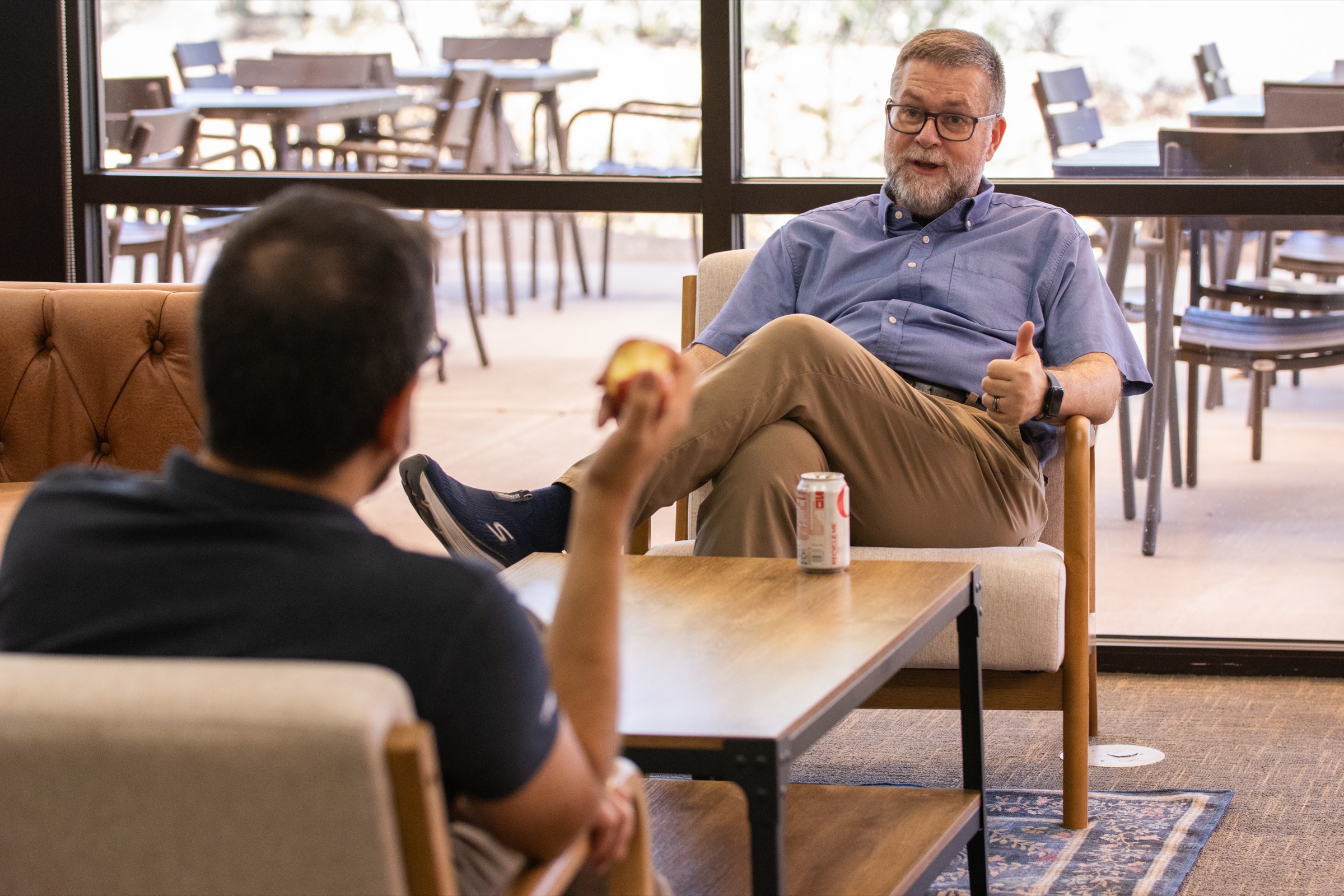
Seminary students in conversation outside the chapel
Members in conversation after the morning service. Hospitality is a slow, stubborn discipline at Trinity.

Life together

A church learns its life by spending time on the same pew.

Trinity is intentionally small enough that you will be known and large enough that you will not be alone. Our congregation gathers across ages — covenant children, college students, young families, retired pastors — in a single body around the same Word and the same Table.

If you are new, the easiest thing is to come and sit. The harder thing — and the better thing — is to come back next week.

What membership looks like →
faq-section

Frequently asked questions, expanded list. For getting-started landings and visitor-oriented pages.

Block

For first-time visitors

Questions we hear from visitors.

The honest ones. If yours is not on this list, we would be glad to hear it — the church office answers email and the phone, and the elders are happy to talk on a weekday evening.

What is a Reformed church?

Reformed churches confess the historic Protestant faith as recovered in the sixteenth century — salvation by grace alone, through faith alone, in Christ alone, on the authority of Scripture alone, to the glory of God alone. Our liturgy, preaching, and government are shaped by the Westminster Standards and the Three Forms of Unity.

Do I need to be a member to attend?

No. Lord’s day worship is open to the public, and we delight in visitors. Membership is for those who, after a season of worshipping with us, wish to formally commit themselves to the life and discipline of this congregation.

What does a service look like?

A historic Reformed liturgy: a call to worship from the Psalter, a confession of sin and assurance of pardon, the reading of the law, congregational singing of psalms and hymns, the public reading of Scripture, a forty-five-minute expository sermon, the Lord’s Supper each Lord’s day, and a benediction. About seventy-five minutes in total.

Are children welcome in the service?

Yes — gladly and without apology. Trinity is a covenant congregation; children belong in the room with us. There is a staffed nursery for those under three, but no children’s church above that age. The fidgets and noises of small saints are expected and well-received.

May I take communion?

If you are a baptized, professing member in good standing of an evangelical Christian church — not under church discipline, and able to examine yourself by the standard of First Corinthians 11 — you are welcome to the Table with us. The pastor offers a brief fencing of the Table each Lord’s day.

How do I get plugged in beyond Sunday morning?

Our adult Bible classes meet at 11:00 AM between services, and most members belong to a Wednesday-evening parish-group that meets in homes around the city. The pastor or an elder can help match you with a group near where you live.

Still have questions? Email the church office →

three-card

Three equal cards in a row. The canonical “commitments” or “value props” section.

Block

What we are about

Three ordinary means of grace.

Reformed churches across centuries and continents have ordered their common life around the same three appointments. Trinity makes no claim to invent anything — only to keep doing what the church has always done.

I · Word

The preached Word.

Consecutive expository preaching from whole books of Scripture, week by week. The pulpit is the heart of the room and the spine of our common life.

“Faith comes by hearing” · Romans 10:17
II · Sacrament

The Lord’s Table.

Holy Communion every Lord’s day — bread and wine offered to baptized believers as a means of grace, sealing the promises of the gospel to weary saints.

“The cup of blessing which we bless” · 1 Corinthians 10:16
III · Prayer

The prayers of the people.

Pastoral prayer, congregational prayer, and the prayer the Lord taught us — offered each Sunday and across our parish-group homes through the week.

“Pray without ceasing” · 1 Thessalonians 5:17
accordion-v1

List-style accordion: full-width rows with hairline dividers and an Inter eyebrow above each Fraunces question. Best for long-form FAQs and policy lists.

Block

Long-form FAQ

The longer questions, answered at length.

For visitors who want to understand not just what we do, but why — with the unhurried, paragraph-length answers a thoughtful question deserves.

Because Scripture is the Word God has actually given us, and Scripture is given to us in the form of books. When we preach consecutively through Mark or Romans or Ezra, the agenda for the next sermon is set not by the pastor’s mood or the news of the week, but by what comes next in the text.

This protects both the pastor and the congregation. The pastor cannot ride a hobby-horse for fifty Sundays in a row. The congregation receives the whole counsel of God — including the difficult, neglected, and uncomfortable parts — rather than a curated highlight reel.

It is also how the church has historically read the Bible: chapter by chapter, with the whole congregation listening together. We are not innovators here. We are simply trying to keep doing what Augustine and Calvin and Spurgeon all did from their pulpits, and to do it with a little less flourish.

The early church gathered weekly “to break bread,” and Calvin’s deep desire was for weekly Communion to be the practice of every Reformed church — a desire frustrated only by the city council of Geneva. We are recovering what the Reformers wanted but did not get.

The Supper is not an interruption of the service; it is the climax of it. The sermon proclaims the gospel in word; the Table proclaims the same gospel in sign and seal. To preach grace and then send the congregation home without the visible promise feels, to us, like a meal that ends before dessert. Each Lord’s Day we hear the Word, then we taste it.

We mean that the children of believing parents are members of the visible church, set apart by the Lord, and entitled to the sign and seal of the covenant in baptism. We do not require our children to make a credible profession of faith before treating them as belonging.

Practically, this means our children are baptized as infants, are present in the worshipping assembly from infancy, and grow up hearing the Word preached, the prayers offered, and the Supper administered — long before they consciously remember any of it. We trust the ordinary means of grace to work over decades, not weeks.

Trinity is a Presbyterian congregation, governed by a session of elders — ordained men, called by the congregation, examined and ordained by the wider presbytery. The session has spiritual oversight of the congregation. A board of deacons attends to mercy ministry and the temporal affairs of the church.

Above the session is the Presbytery of the Southwest, a regional body of pastors and ruling elders to which Trinity is accountable, and beyond that the General Assembly of the Orthodox Presbyterian Church. No elder rules alone; no congregation is sovereign over itself; no session can be brought before any body but the church. It is a slow, deliberate, and ancient form of government.

Then come anyway. Sit in the back. Listen. Ask the pastor or an elder a question after the service, or none at all. We have no quarrel with people who are honestly working out what they believe. We have a quarrel only with the assumption that the question can be answered without ever sitting under the preached Word in the company of the saints.

Christians have always been made, not manufactured. They are made over years — in the slow, ordinary work of Word, Sacrament, and Prayer, in the company of older Christians, with all their doubts and questions intact.

accordion-v2

Card-style accordion: each item is a bordered putty-cream card with a hover lift. Best for visually segmented content where each entry carries weight.

Block

What we confess

Four positions, in our own words.

The places we are most often asked to clarify what, exactly, a confessional Reformed congregation believes. Each is a summary — the standards themselves are the authority.

The sixty-six books of the Old and New Testaments are the verbal, plenary, inerrant Word of God — the only infallible rule of faith and life. Tradition, reason, and experience are gifts of God for the church’s good, but they are servants under the Word, never above it.

Baptism is the New Covenant sign of initiation into the visible church, administered by ordained ministers, with water, in the name of the Father, Son, and Holy Spirit. We baptize believing adults converted from outside the church, and the infant children of believing parents, on the basis of the unity of the covenant of grace across the testaments.

The first day of the week is the Christian Sabbath — a day for the public and private exercises of worship and for resting from our common employments and recreations. We keep it not as a burden but as a gift — one day in seven, given by the Lord, set apart for him and for our good.

The church is a spiritual society, distinct from civil society, with its own King, ministers, and means of grace. We labor in our common callings — as carpenters, lawyers, teachers, mothers — for the good of our neighbors, but the pulpit is reserved for the proclamation of the gospel, not for political program. We are quiet about many things our neighbors expect us to be loud about, and louder than expected about a few others.

tab-section-v1

Horizontal tabs across the top, content below. The orange underline marks the active tab. For “by audience” content.

Block

Find your way in

Where to begin, depending on who you are.

The same congregation looks different from different angles. Choose the angle nearest to where you stand today.

For prospective students

Begin with a conversation, not a brochure.

Phoenix Seminary admits a small number of students each fall. Before any application, the dean asks every prospective student to spend a Sunday at Trinity and a weekday hour with one of our faculty. We have found that the people we ought to be training are not always the people who walk in confident, and the people who walk in confident are not always the ones we ought to be training.

If that resonates, write to the admissions office and we will arrange both visits at no cost.

  • Sit in on a Lord’s Day morning service
  • Meet with the dean for ninety minutes
  • Visit a Hebrew or Greek seminar in session
  • Tour the library and student commons
  • Coffee with two current M.Div. students
For current students

The student handbook is the source; this page is the summary.

Phoenix Seminary keeps an in-residence rhythm: Tuesday through Friday mornings in seminars, Tuesday evenings in chapel, Wednesday afternoons in language drill, and Friday afternoons reserved for unhurried study. The library is open until midnight Sunday through Thursday during full term.

Most resident students take four courses a term, plus the required language sequence, plus a weekly preaching practicum from year two onward.

  • Term begins August 28
  • Reading week October 14–18
  • Reformation Lectures November 6–7
  • Final examinations December 9–13
  • Senior thesis defenses by April 15
For pastors in ministry

Continuing-education tracks for the called and ordained.

Phoenix Seminary offers a Doctor of Ministry program designed around the rhythms of pastoral life: two summer residencies of three weeks, sustained reading and writing in the parish, a defended ministry thesis. Concentrations are available in Expository Preaching, Reformed Pastoral Theology, and Confessional Catechesis.

The cohort model means you study with the same twelve pastors across three to five years — long enough to become each other’s lasting fraternity.

  • D.Min. cohort begins each June
  • Th.M. residency · January and June
  • Pastoral fraternal · first Mondays
  • Reformation Lectures, free for clergy
  • Sabbatical scholar program (M-F desks)
For sending congregations

What it looks like to send a candidate to Phoenix.

Most of our students arrive with the recommendation of a sending session and the prayers of a sending congregation. We treat that relationship as sacred, and we keep our sending churches in our weekly prayer cycle — pastors and elders praying by name for the men and women you have sent us.

Twice a year we send sending churches a letter from the dean, with a candid update on each of their candidates’ progress, growth, and standing.

  • Annual visit from a faculty member
  • Sending-pastor lunches each March
  • Quarterly written candidate reports
  • Field-education placement coordination
  • Internship and ordination-exam support
tab-section-v2

Vertical tabs left, panel right. EB Garamond body for an editorial reading feel; Inter UI for the rail labels.

Block

Programs of study

Four resident graduate programs.

Each of our four programs is shaped by the same conviction — that scholarly rigor and a shepherd’s heart are not at odds, but ought to grow together, slowly, over years of study.

Resident · Cohort of fourteen

Master of Divinity

The pastoral vocation, prepared for over four full years.

Our flagship program, designed for the called, examined, and ordainable pastor. Four years of biblical languages, systematic theology, church history, and supervised pastoral formation, culminating in a senior thesis defended before the faculty — with a year-long preaching practicum in the field-education church.

The M.Div. is the program our denomination’s presbyteries treat as the ordinary path to ordination, and most of our graduates pastor confessional Reformed congregations within five years of completion.

Credits92 hrs
Length3–4 yrs
Cohort14 ea fall
Resident · Research-oriented

Master of Arts · Biblical Studies

A research-focused master’s for parish-adjacent and academic vocations.

A two-year program for those preparing for doctoral work, classical-school humanities teaching, missionary translation, or seminary teaching assistance. Strong emphasis on Hebrew, Greek, and exegetical method, with a research thesis defended in the second year.

The M.A. shares its first-year language sequence with the M.Div., which means our M.A. students sit in the same Hebrew seminar as the men preparing for the pulpit — and graduate, often, with deeper philological training than they would receive at a research university of three times the size.

Credits64 hrs
Length2 yrs
Thesis12k words
Cohort · Practitioner doctorate

Doctor of Ministry

A practitioner’s doctorate for the experienced pastor.

For pastors with at least five years post-ordination, who wish to deepen the craft of consecutive expository preaching, Reformed pastoral theology, or confessional catechesis. Two summer residencies of three weeks, a sustained reading-and-writing program in the parish, and a defended ministry thesis.

Cohorts of twelve. The first-summer residency falls in early June; the program completes in three to five years depending on the candidate’s parish rhythm. Tuition is concession-priced for ordained men in confessional Reformed congregations.

Credits36 hrs
Length3–5 yrs
Cohort12 ea June
Bridge · Pre-doctoral

Master of Theology

A bridge degree for the M.Div. graduate considering academic work.

A one-to-two-year program with concentrations in Old Testament, New Testament, Systematic Theology, and Historical Theology. Required for application to most Reformed Ph.D. programs, and useful for the parish pastor who wishes to keep a foot in scholarly conversation without leaving the pulpit.

Th.M. candidates sit advanced seminars with the doctoral-track faculty, present at the Reformation Lectures, and complete a thesis of original research worthy of submission to a peer-reviewed journal.

Credits32 hrs
Length1–2 yrs
Concentr.OT · NT · ST · HT
slider-v1

Image gallery with arrow nav, dot indicators, and swipe support. Minimal chrome — the photography carries the section.

Block

A walk through the seminary

Phoenix Seminary in five photographs.

Library, classroom, chapel, courtyard, and the conversation that happens, slowly, between all of them.

Students reading at long oak tables in the seminary library
The Robertson Library Open until midnight from August through May. The reference desk keeps a small candle lit through the term.
A faculty member teaching from a lectern in a small seminar room
The Hebrew seminar Twelve first-year students translate Genesis 22 in the original. Tuesdays and Thursdays at 9:00 AM.
Two students in conversation outside the chapel
After chapel The unhurried conversations that follow the ten-thirty Wednesday service. Often where the real work happens.
Aerial view of the seminary campus and surrounding desert
The campus, from above Fourteen buildings on twenty-two acres of north Phoenix desert. The bell tower marks the chapel; the long building is the library.
A student reading a hardback book at a desk lit by a single lamp
The reading desks Each resident M.Div. student is assigned a numbered desk on the library mezzanine for the duration of his program. Pencils and a green-shaded lamp included.
slider-v2

Testimonial slider on a navy ground. Dot indicators, no arrows — cleaner editorial feel for quote-led content.

Block

From our alumni

What graduates say, ten years out.

Not what they thought of the seminary the week of commencement — what they think of it now, after a decade of pulpit ministry, lecture-hall teaching, or parish life.

The seminary did not produce in me a finished pastor — no school can. What it did was give me a Hebrew Bible I could actually read, a doctrine of preaching I still trust, and twelve fraternal brothers I still telephone when the work is hard.
JM
John Marsden M.Div. · Class of 2014
The reading desks on the mezzanine, the long Tuesday seminars, and the patient correction of my Greek participles — that is what I remember. The faculty believed that what I would do in a parish for forty years was worth two years of careful preparation, and they were right.
EH
Eliza Hartwell M.A. Biblical Studies · Class of 2017
I came to the D.Min. cohort already ten years into a pastorate, with the bad habits a decade of solo work makes possible. Three weeks in residence each summer, with eleven other pastors who would not let me cut corners, was the most formative continuing education I have done.
RB
Robert Buchanan D.Min. · Class of 2019
What you do not learn at Phoenix is how to be impressive. What you learn is how to read Scripture slowly in the original, how to preach without flourish, and how to bury people you have known for thirty years. The first two are the skill of a pastor; the third is, in the end, his vocation.
DC
David Carmichael M.Div. · Class of 2008 · Th.M. 2011